Welcome to FengYun-AIR data portal
FengYun satellite Atmospheric composition Infrared Retrieval (FY-AIR) data portal @ Peking University
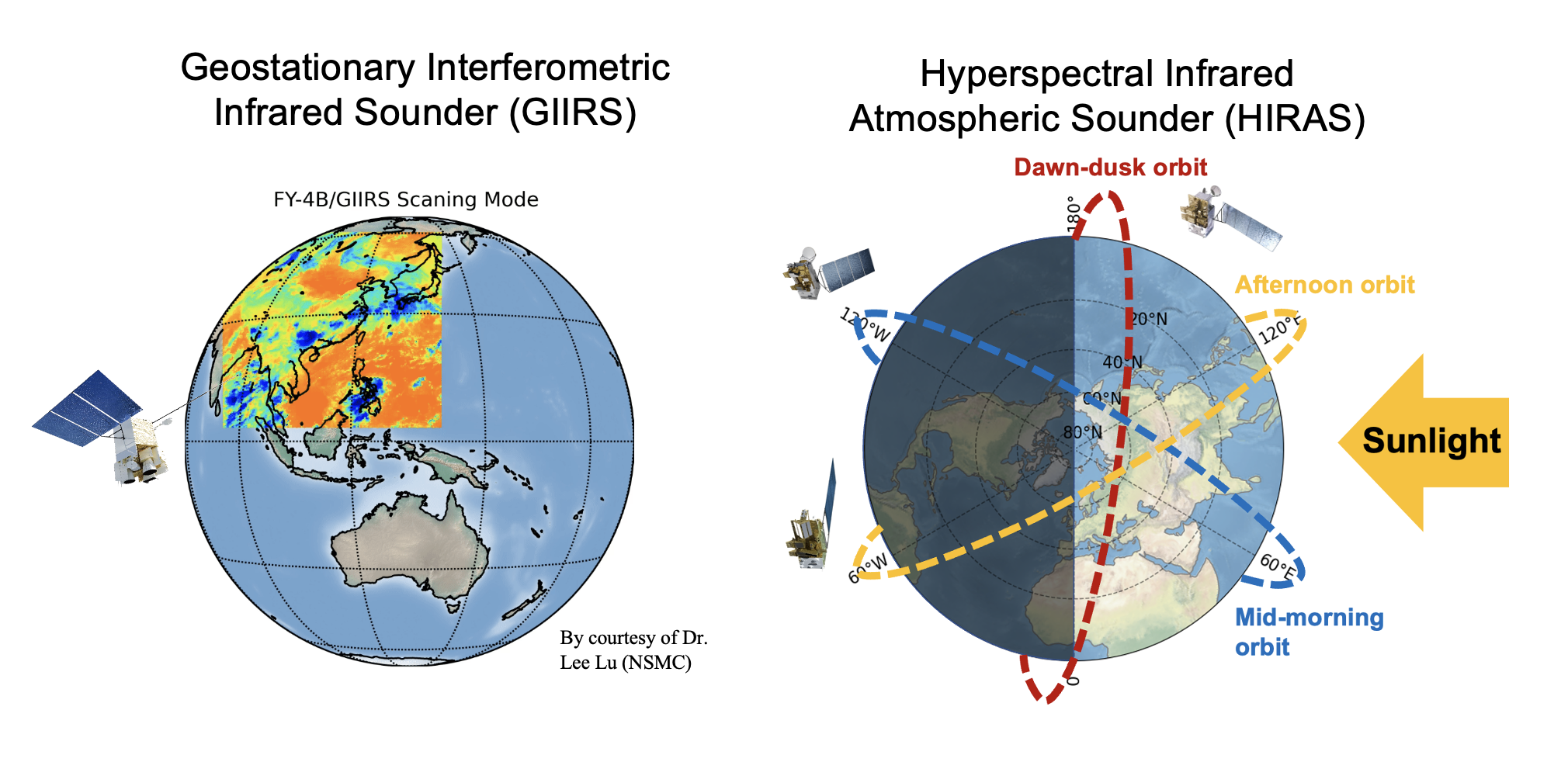
Overview: Earth's atmosphere monitored from China's FengYun GEO/LEO satellites
The Geostationary Interferometric Infrared Sounder (GIIRS) onboard China’s FengYun-4 satellite series (FY-4A/B) is the first GEO hyperspectral infrared sounder. FY-4A and FY-4B currently operate at 86.5°E and 105°E, respectively. The GIIRS observations cover most of East Asia with a focus on China, with a 2-hour observing cycle. GIIRS measures at a 12 km spatial resolution at nadir and was recently used to retrieve ammonia (NH3; Zeng et al. 2023a), carbon monoxide (CO; Zeng et al. 2023b), formic acid (HCOOH; Zeng et al. 2024), and ozone (O3; Liu et al., 2025).
China's FengYun-3 (FY-3) series of meteorological satellites have formed a constellation of hyperspectral infrared sounders in dawn-dusk, mid-morning, and afternoon sun-synchronous orbits (see the above Figure), providing six global coverages each day with equatorial crossing times at 5:30 am/pm (FY-3E), 10:00 am/pm (FY-3F), and 2:00 am/pm (FY-3D). While the mid-morning and early afternoon orbits are already used by sounders like IASI and TROPOMI (or CrIS), respectively, there is an important observational gap during the dawn-dusk which is filled by FY-3E launched in 2021. It has already been shown that the High Spectral Infrared Atmospheric Sounder (HIRAS) on board the FY-3 series can detect wildfire-induced enhancements of trace gases, including carbon monoxide, volatile organic compounds, and volcanic sulfur dioxide (Zeng et al., 2025; Hua et al., 2025; Zeng et al., 2025).
Updates
- TOP: LEO HIRAS-II NH3 [2023-2025 for FY-3E and 2024-2025 for FY-3F] available on Zenodo [link].
- TOP: GEO GIIRS-B NH3 (2022/07 to 2025/06) available on Zenodo [link].
- 2026/06 Global and diurnal NH3 from a LEO constellation paper published as an AMT highlight paper. [link]
- 2026/06 GIIRS NH3 paper published in ACP. [link].
- 2026/05 GIIRS and HIRAS dust observation paper published in JGR-A. [link]
- 2025/09 HIRAS SO2 paper published in RSE. [link]
- 2025/09 GIIRS NH3, CO, HCOOH, and O3 data released.
- 2025/08 FY-AIR project website created.